AI Wearables: Your Body Has a Dashboard Now
Explore why AI wearables represent an emerging investment opportunity as artificial intelligence, health data, and smart devices converge.

Artificial intelligence is moving beyond our screens and onto our bodies, with a new generation of wearable devices that can track everything from sleep and hormones to focus, memory, and daily conversations. These technologies promise highly personalized insights that can improve health, productivity, and decision-making, while also raising important questions about privacy, trust, and data ownership. In this article, I share my firsthand experience living with six AI wearables — and what they reveal about the future of human-computer interaction.
A woman at the coffee shop stared at me for a good ten seconds before she said anything.
I was sitting across from her at a shared table at Blue Bottle, laptop open, working through a weekend due diligence session. On my left hand, an Oura ring. On my wrist, a Clair Health bracelet. Around my neck, a small disc on a lanyard that I’d been forgetting was there. On my face, a pair of glasses that looked almost normal but I switched over to another pair of glasses mid-task. And on my head, the thing that finally made her say something: a slim white headband wrapped just above my ears.
“Are you okay?” she asked.
I laughed. “I’m great, actually. That’s kind of the point.”
I’ve been wearing AI for the past few weeks and not in the sci-fi sense: there’s nothing invasive to my body like a neural implant, no AR overlay telling me calorie counts on my latte. Just six devices, each one quietly doing something useful on or around my body. And the experience has been, genuinely, a little bit mind-bending.
I’d love to share what I’ve been wearing, why it matters, and what it’s making me think about, as someone who invests in innovations like this for a living – as a Partner for Alumni Ventures’ AI First Fund, I spend most of my working hours evaluating exactly this kind of technology, and also as someone who just wants to get through a Monday without running on empty.
A Day in the Life
Let me walk you through how this actually looks.
Morning. As soon as I wake up, I check my Oura ring score (an Alumni Ventures portfolio company). For the uninitiated: Oura is a smart ring that tracks your sleep, heart rate variability, body temperature, and a dozen other signals while you’re unconscious, and distills it all into a single “readiness” number from 1 to 100 when you wake up. On a good week, I’m in the mid-80s. On the Sunday after a late Saturday dinner and two glasses of wine, I was at 71.
See video policy below.
Portfolio companies are shown for illustrative purposes only; not necessarily indicative of any AV fund or investor. Investments shown are not available to future investors, except potentially in the case of follow-on investments. Past performance does not guarantee future results.

I skipped the espresso and went for a tea instead.
That’s it. That’s the whole interaction. The ring didn’t lecture me. It just showed me a number, and I made a call. But that number came from tracking my sleep stages, my resting heart rate, and my body temperature overnight, comparing it to my baseline, not some generic population average. That’s the part that makes it different from a regular fitness tracker. Oura knows me.
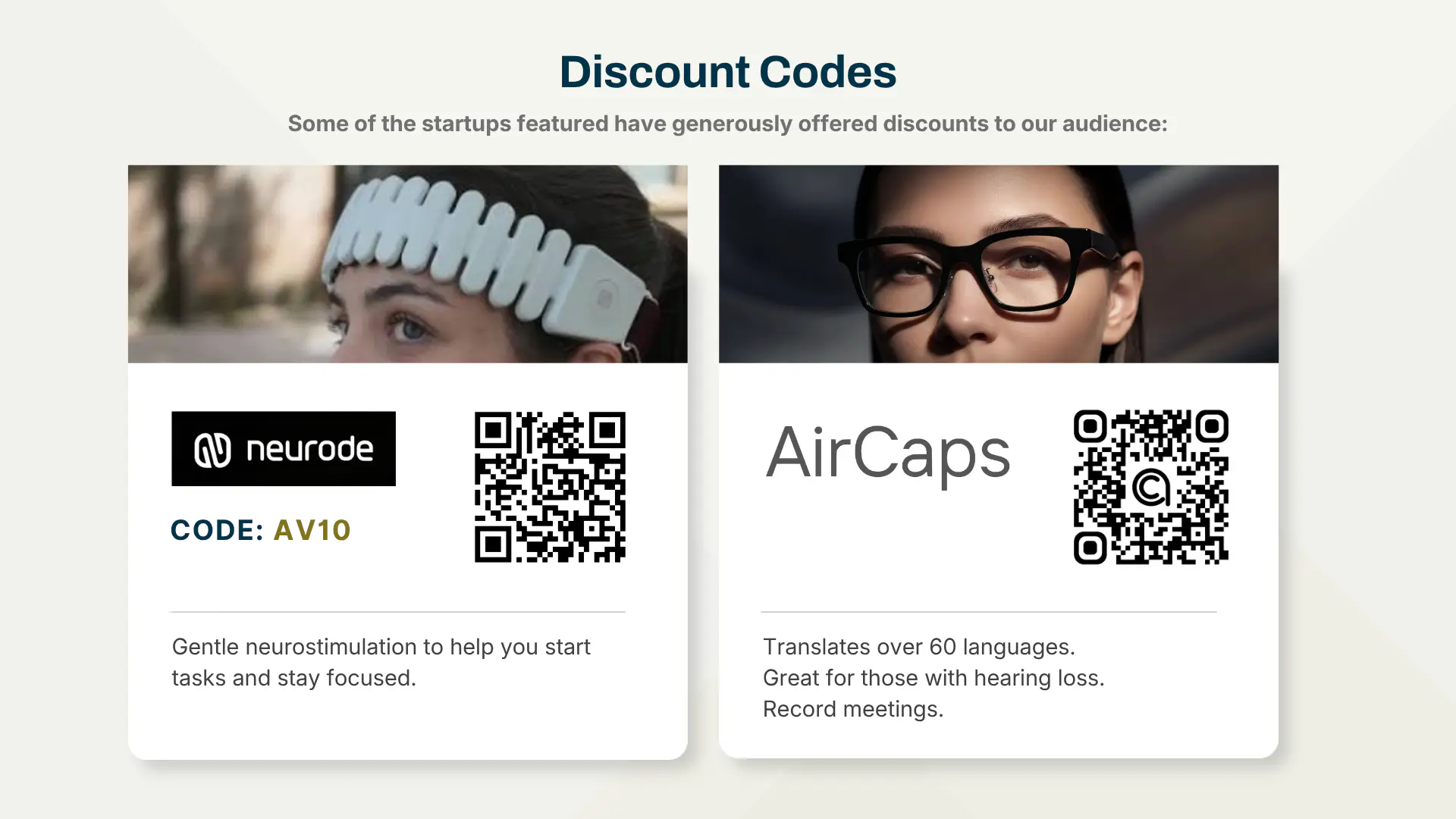
Getting dressed. I put on my Taya necklace (Alumni Ventures’ portfolio company) and it blends seamlessly with my daily jewelry, and I also put on the Aircaps glasses (Alumni Ventures’ portfolio company) and tuck my Meta glasses in my purse for later. Taya is a small AI pendant that functions as a wearable memory. It listens to your conversations throughout the day, transcribes them, and surfaces summaries and action items later.

I like Taya because 1) it’s not always on and 2) it only recognizes my voice and respects the privacy of others around me and 3) it helps me capture my shower thoughts, cooking epiphany etc.
Aircaps are AI smart glasses: they can transcribe in real time – great for people with hearing losses or who don’t want to miss a thing from their meetings. Not to mention it can translate 60 languages in real time, perfect when I speak with our international partners and founders. I use Meta glasses to capture moments with my kids where I can’t pull out my phone fast enough to capture their giggles or their new silly moments.
Together, they make me feel a little bit like a walking field recorder. Which is either thrilling or unsettling depending on who you ask. More on that in a moment.
The focus block. This is where the Neurode headband comes in, and honestly, I was the most skeptical about this one going in. Neurode is a slim headband that uses non-invasive neurostimulation: gentle electrical pulses to optimize executive function. The claim is that 20 minutes a session helps you start tasks more easily, reduce procrastination, and stay locked in longer. It’s clinically backed and has been getting serious traction with the ADHD and burnout communities.
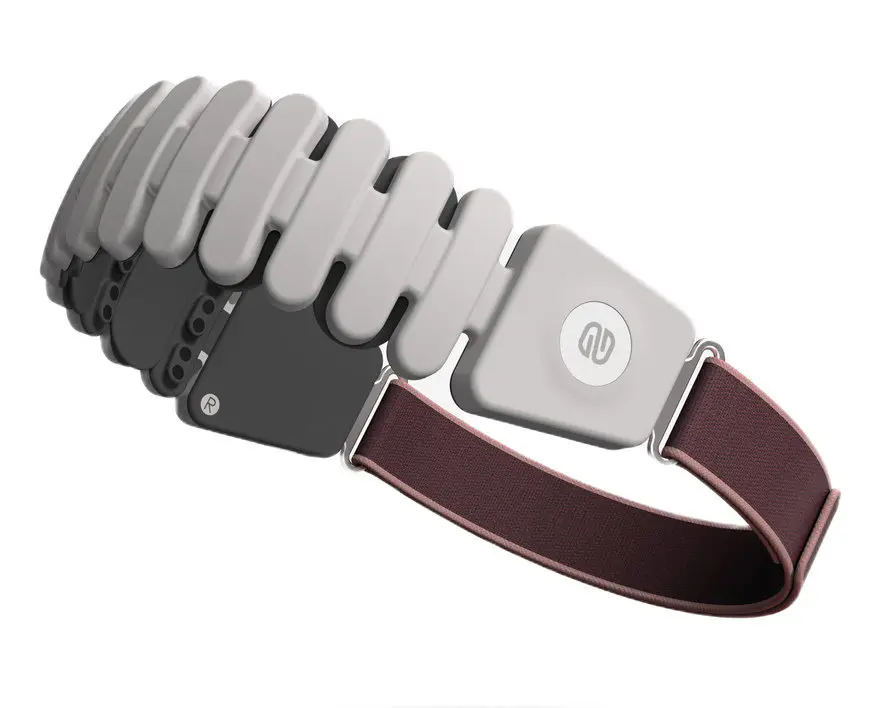
I put it on, set a timer, and opened my due diligence memo.
I don’t know exactly what happened in those 20 minutes. But I didn’t check my phone once, which for me, is genuinely remarkable. Whether that’s the neurostimulation or the placebo effect of wearing something that says “focus time,” I’m not sure I care. The outcome was the same.
All day, quietly, the Clair Health bracelet sits on my wrist. Clair is building one of the first continuous, noninvasive hormone monitor, tracking estrogen, progesterone, Luteinizing Hormone (LH), Follicle-Stimulating Hormone (FSH), and other markers in real time for women’s health. It also has an “Ask Clair” feature: a health chatbot grounded in the user’s own data that can answer questions like “why am I so tired today?” with something more substantive than a shrug.

For anyone who has ever wondered why their energy, mood, or performance feels mysteriously different week to week. This is the device that starts to give that shape.
Wait, How Does This Actually Work?
Here’s the part where most tech pieces lose you, so let me try not to.
All six of these devices are, at their core, sensors with a cloud brain. The device itself collects raw data: audio, biometrics, brainwave patterns, and hormone proxies. That data gets sent to an AI model either a large language model (LLM) like GPT or Claude, or a proprietary model trained on a specific dataset, and something useful comes back. A summary. A score. A recommendation. A response.
Think of the device as your ears and eyes and the AI model is the brain doing the processing.
Aircaps and Taya are the most “LLM-native” of the group. They’re essentially wearable interfaces into a language model. You speak, the audio is transcribed, the LLM interprets, and you get a response or a summary. The intelligence lives in the cloud, and the device is the elegant hardware wrapper that makes it wearable rather than phone-bound.
Meta glasses are multimodal-first hardware with a heavier stack: a camera, a five-microphone array, and a speaker. You say “Hey Meta” to trigger the on-device wake detection, and from there your phone relays the request to Meta’s servers, where photos and videos are stored in the cloud for 30 days. Meanwhile its AI capabilities are powered by its proprietary Llama large language models which are open source.
Oura has trained proprietary models on enormous datasets of biometric signals such as years of sleep data, heart rate patterns, brainwave readings from thousands of users. When your ring gives you a readiness score, it’s not consulting GPT. It’s running your body’s signals against a model that has learned what “ready” actually looks like, at a physiological level.
People with focus difficulties often show lower activation in the prefrontal cortex, which is the part of the brain involved in attention, executive function, and cognitive control. Neurode says its non-invasive stimulation is designed to increase activity in that region. The goal is to help people better access their existing focus capacity.
Clair sits somewhere in between: proprietary hardware doing continuous hormone sensing, with an AI layer on top that interprets those signals and communicates with you conversationally.
The result is a new kind of interface: Not a screen you look at but a body you listen to.
Okay, But Who Has My Data? And My Privacy?
These are important questions and worth thinking about.
The privacy stakes are not equal across all six. The highest sensitivity, in my view, sits with the Meta glasses and Kylie Jenner is in its latest campaign to help the tech with a “beauty lift.” With Meta glasses you can take pictures and videos more frictionlessly than your phone, you can listen to music, ask it for directions etc. But, the glasses are always-on by design. The woman at the coffee shop isn’t consenting to being in my field of view all day. That’s worth sitting with.
Aircaps can transcribe and translate in real-time and it does raise a related question: what about the other people in the room if they don’t want to be recorded? Recording devices depend on ambient recording, which means anyone you’re talking to is also being recorded while some devices prompt you to notify others. Many don’t. Taya only records your own voice which is a big deferentiator.
Oura and Neurode are collecting deeply personal biometric data, but the privacy risk profile is lower because no one else is in the frame, and the data is about your body, not your conversations. Neurode uses personal and sensitive data, including de-identified Apple Health Data for research, testing, and personalizing app features like brain-activity insights, with the goal of increasing focus and productivity. Apple Health Data is kept only on servers in Australia or the U.S. and isn’t transferred to jurisdictions with weaker privacy protections. Users can request access to their data (free, aside from possible admin costs) or ask to have it deleted or de-identified by emailing the company directly, with Neurode committing to act within 30 days and confirm completion.
Continuous hormone data is the most personal reproductive health data for a woman. In 2026, that data carries legal and political weight that it didn’t five years ago. With Clair, all hormone inference happens on the user’s device. When the wearable captures signals, that data travels through Bluetooth to the user’s phone and goes no further. For users who want cloud backup, Clair offers zero-knowledge encryption, which means data is encrypted on the device with a user-created passphrase before anything uploads. Clair stores only the encrypted file and cannot decrypt it, as the platform is designed with privacy as the default.
The deal you’re making with every one of these devices is the same: more usefulness in exchange for more data. That’s not a bad deal but it’s worth knowing you’re making it.
Why Is This Market So Crowded Right Now?
If you’ve gone shopping for a wearable AI device in the last six months, you’ve ended up in a rabbit hole. There are a lot of these things.
For instance, in the AI glasses category alone there’s a three-way platform war of Meta, Google and Apple. Currently Meta is the runaway leader. Meta’s Reality Labs unit, which builds virtual reality and augmented reality technology as well as wearable devices brought in $402 million in sales according to its 2026 first quarter’s earnings report. Its camera-equipped Ray-Ban glasses developed in partnership with EssilorLuxottica is “one of the fastest-growing consumer products of our lifetimes,” according to Meta.
Google/Samsung are the challengers. Consumers can expect Android extended reality (XR) audio glasses, engineered by Samsung with Warby Parker and Gentle Monster as design partners, to be launched in fall 2026, working across both Android and iOS.
Apple is reportedly aiming to release smart glasses by the end of 2026, matching Ray-Ban Meta’s camera, microphone, and AI feature set, with Siri as the interface.
In the voice recording/note-taking AI category where Taya operates, there are a lot of other players: Plaud has over 1.5 million users who wear Plaud as a necklace, wristband, clip, or pin. Pocket is a thin, business-card-like AI recorder that can fit into your wallet or be attached to the back of your phone. Friend, the $129 AI companion necklace that got a notably brutal reception, with reviewers noting the always-listening design created social friction rather than connection.
The smart ring category is less flashy and more mature. Oura remains the most recognizable name, but it’s no longer the default, as competition has intensified with Samsung Galaxy Ring and Ultrahuman.

So why does this market keep expanding? Because the data layer that lives on your body is the next platform, and everyone knows it.
Think about the arc. We built AI that knows what you search for. Then we built AI that knows what you buy, who you text, and how you spend your time. The wearable era is about building AI that knows how you slept, how focused you were, how your hormones are cycling, and what you said out loud at 2 p.m. on a Tuesday. That is an entirely different level of personalization and an entirely different level of capability.
The global market for all wearable tech is valued at roughly $238 billion in 2026, climbing toward $931 billion by 2035 at a 16.35% compound annual growth rate. The winners won’t be whoever ships the most features, they’ll be whoever earns enough trust that you actually keep the device on your body, day after day, and let it learn you. If removing the product feels like a loss then congratulations, the product has achieved an experience – behavior fit.
This Isn’t a Product Category. It’s a Relationship.
The woman at the coffee shop eventually asked me what I was testing.
I gave her the quick version: sleep ring, hormone bracelet, focus headband, AI necklace, smart glasses x2. She looked at me like I’d just described a new religion.
“Does it work?” she asked.
I thought about the 71 readiness score and the skipped espresso. The 20-minute focus block where I didn’t check my phone. The Clair app that gave me a reason, not a mystery, for why I was tired on Sunday. The Taya summary that reminded me of something important I’d said out loud and would have otherwise forgotten.
“Yeah,” I said. “It kind of does.”
We’ve spent a decade building AI that knows what you type. The next decade is about building AI that knows how you actually feel. That shift is already underway and it’s just quieter than you’d expect, and it’s wearing very good hardware.
Interested in Seeing Curated Venture Deals?
- Home
Easy Sign-Up
Click a button. 5 seconds. - Home
No Obligation to Invest
Only invest in deals you like. - Home
Co-Invest Alongside Leading VCs
Frequent co-investors include a16z, Sequoia, Khosla, Accel, and more. - Home
Deal Transparency
Due Diligence and Investment Memos provided. Live Deal discussions with our investment teams.
This communication is from Alumni Ventures, a for-profit venture capital company that is not affiliated with or endorsed by any school. It is not personalized advice, and AV only provides advice to its client funds. This communication is neither an offer to sell, nor a solicitation of an offer to purchase, any security. Such offers are made only pursuant to the formal offering documents for the fund(s) concerned, and describe significant risks and other material information that should be carefully considered before investing. For additional information, please see here. Achievement of investment objectives, including any amount of investment return, cannot be guaranteed. Co-investors are shown for illustrative purposes only, do not reflect all organizations with which AV co-invests, and do not necessarily indicate future co-investors. Example portfolio companies shown are not available to future investors, except potentially in the case of follow-on investments. Venture capital investing involves substantial risk, including risk of loss of all capital invested. Diversification cannot prevent investment loss; it is a strategy to mitigate investment risk. This communication includes forward-looking statements, generally consisting of any statement pertaining to any issue other than historical fact, including without limitation predictions, financial projections, the anticipated results of the execution of any plan or strategy, the expectation or belief of the speaker, or other events or circumstances to exist in the future. Forward-looking statements are not representations of actual fact, depend on certain assumptions that may not be realized, and are not guaranteed to occur. Any forward-looking statements included in this communication speak only as of the date of the communication. AV and its affiliates disclaim any obligation to update, amend, or alter such forward-looking statements, whether due to subsequent events, new information, or otherwise.