Distilling Oil: The Unseen Cost of the Strait Closure

Deal or no deal, diplomacy alone doesn’t fix the broken supply chain. Ships move slowly, and a barrel of crude oil is a whole lot more than gas at the pump — it’s the feedstock for everything from plastics to asphalt
A deal, of sorts, had been struck. On June 17, the United States and Iran signed a memorandum of understanding — a 60-day ceasefire framework, conspicuously not a final peace agreement — that included provisions to reopen the Strait of Hormuz, the narrow, 21-mile chokepoint through which roughly 20% of the world’s oil flows every single day according to the U.S. Energy Information Administration (EIA).
The fine print told a murky story. Iran had already signaled it intended to charge “service fees” for vessels transiting the Strait, directly contradicting the MOU’s language around toll-free passage. The nuclear questions that actually matter — enrichment levels, highly enriched uranium stockpiles — were deferred to future negotiations that hadn’t even been scheduled. Most serious analysts landed somewhere between cautious and deeply skeptical about whether the framework would hold.
Then, in early July, it indeed collapsed.
But what most don’t appreciate is that even if the deal did hold (or if a new one is struck tomorrow, miraculously), the simple physics of supply chain doesn’t care. Ships move slowly. Agonizingly, oceanically slowly. A fully loaded supertanker — a VLCC (Very Large Crude Carrier) hauling 2 million barrels of crude — cruises at around 15 knots per INTERTANKO vessel classification standards. That’s about 17 miles per hour, roughly the speed of a casual bicycle ride. The vessels that diverted away from the Strait weeks ago, rerouting around the Cape of Good Hope to add 3,500 miles and 10-14 extra days to their journeys, are still out there. They don’t materialize at their destinations just because a deal was signed. And the cargoes that never shipped at all — that sat in holding patterns, deferred as insurance premiums spiked and shippers hedged — those delays are baked in. Supply chains don’t snap back like rubber bands. They unspool slowly, and they re-spool even more slowly.
But there’s a second, less-told part of this story that gets almost no airtime, and it’s arguably the more important one. It’s the story of the long tail of economic disruption that an oil supply chain shock spreads across the global economy.
When most people hear “oil supply disruption,” they think only about gasoline prices. As a Principal at Alumni Ventures focused on supply chain and logistics investing, this surface-level framing is what I spend a lot of time pushing past. What few consider is that crude oil is not merely fuel. It is the molecular feedstock for an enormous swath of modern civilization, including plastics, pharmaceuticals, fertilizers, synthetic fabrics, and roads. A disruption at the Strait doesn’t just slow down what’s in your gas tank. It gums up the entire bloodstream of the industrial economy. To understand why, you need to understand what happens when crude oil gets refined.
Start Investing With the Logistics and Transportation Syndicate Today
Take 5 seconds. No document uploads.
The Tower
At the heart of every oil refinery stands a distillation column: a towering steel cylinder, often 150 feet tall, running at extreme temperatures. Raw crude oil is pumped in and heated to approximately 350 to 400 degrees Celsius at the base. As the vapors rise through the tower, they cool. Different hydrocarbon molecules condense at different temperatures, separating out at different heights — lightest at the top, heaviest at the bottom. What emerges is not one product. It is a cascade of them, each with a distinct role in keeping our civilization running.

Start Investing With the Logistics and Transportation Syndicate Today
Take 5 seconds. No document uploads.
The first to emerge, at the very top of the column, is petroleum gas, which is the lightest fraction. You know it as the fuel that hisses out of the burner on your kitchen stove or your backyard grill. It’s compressed, bottled into those familiar steel cylinders, and distributed to homes across the globe. When the Strait tightens, this supply tightens too.
Next down is gasoline. Surprisingly, gasoline makes up only about 20% of what a barrel of crude oil yields according to the EIA. That’s it. Yet it powers virtually all personal transportation on earth. The global fleet of over 1 billion passenger vehicles runs almost entirely on this one narrow slice of the barrel. The outsized role that gasoline plays in daily life relative to its actual share of crude makes supply shocks acutely visible to consumers almost immediately.
Below that sits naphtha. Less famous than gasoline, but arguably more consequential in the long run. Naphtha is the core building block of petrochemical manufacturing. It’s what gets cracked and reformed into the ethylene and propylene that become plastics. Your water bottle, your phone case, the packaging around your Amazon order, the synthetic fiber in your running shoes — all of it traces back to naphtha. A months-long Strait disruption means naphtha supplies are stressed, which means plastics production is stressed, which means the costs of packaging, construction materials, and consumer goods all creep upward in ways that don’t make for obvious headlines but absolutely show up in earnings calls.
Further down is kerosene, which has a higher boiling point and greater chemical stability. It’s what fills the fuel tanks of commercial aircraft, known as Jet-A fuel. Airlines hedge aggressively on fuel costs, but sustained supply disruption erodes those hedges. Ticket prices follow. So does cargo air freight, which is the fast lane of global supply chains for high-value, time-sensitive goods.
Then comes diesel. Roughly 25% of a barrel by yield per the EIA, diesel runs the heavy economy: freight trucks, trains, construction equipment, and agricultural machinery. The farms that grow our food, the equipment that builds our roads, and the trucks that stock our shelves are all diesel dependent. When diesel supplies tighten, the cost of moving everything goes up.
Heavy fuel oil sits near the bottom of the tower. Viscous and extraordinarily energy-dense, heavy fuel is cheap relative to its energy content. It’s the preferred fuel for the ocean-going vessels that carry 80% of global trade, according to UNCTAD. Yes… The ships that transport oil are themselves powered by a product refined from oil. The irony writes itself. When the Strait closes and heavy fuel supplies tighten, the very vessels meant to carry goods around the disruption become more expensive to operate.
And at the very bottom of the column, what’s left over after everything else has been extracted? Asphalt. The stuff we build roads from. Infrastructure projects, highway repairs, and airport runways are all derivative of crude.

The Cascade
Understanding the products is one thing. Understanding how their simultaneous stress fractures ripple through the real economy is another.
Start with the refinery itself. A crude oil distillation tower is not a tap you can turn on and off. It runs continuously, at enormous temperatures, fed by a steady stream of incoming crude. When that stream thins — when tankers divert, when insurance costs spike, when shippers defer — refineries don’t switch to backup mode. They draw down inventory. Then they throttle throughput. Then, if the disruption is severe enough, they begin choosing: given scarce crude, which outputs do we optimize for? Refineries can adjust their “cut,” running shallower to produce more light fractions or deeper for heavies. But they can’t fully escape the physics.
This is where the modern supply chain’s greatest structural weakness gets exposed: it was designed for predictability, not resilience. Decades of “just-in-time” logic, pioneered in Japanese auto manufacturing and eventually adopted across virtually every sector of the global economy, stripped out inventory buffers in the name of efficiency. Warehouses got leaner. Safety stocks shrank. The assumption baked into the model was that inputs would always arrive on schedule. The Strait closure tested that assumption and found it wanting. Across industries, companies that had been running on weeks of inventory suddenly found themselves with days.
The effects compound in ways that don’t respect sector boundaries. Consider agriculture — not an industry most people associate with oil markets. Diesel powers the tractors that till the fields, the combines that harvest the grain, and the trucks that move both. But there’s a second-order connection that’s even more acute: fertilizer. The nitrogen-based fertilizers that underpin modern industrial farming are synthesized from ammonia, which is produced from natural gas, a product that flows heavily through the Strait. When energy inputs tighten, fertilizer prices follow. When fertilizer prices rise, food production costs rise.
Aviation feels it differently but just as sharply. As mentioned, airlines hedge jet fuel costs months in advance, buying futures contracts to smooth out price volatility. A short disruption can be absorbed. A prolonged one — the kind that lasts long enough to exhaust hedges and requires new contracts at punishing spot prices — forces carriers to make hard choices such as raising fares or cutting routes to avoid absorbing losses. Air cargo is hit even harder since it can’t pass costs to passengers the same way. And air cargo isn’t a luxury. It’s how the global economy moves semiconductors, pharmaceuticals, and perishable food across continents in 24 hours. When that gets expensive, the whole just-in-time logic of global manufacturing starts to wobble.
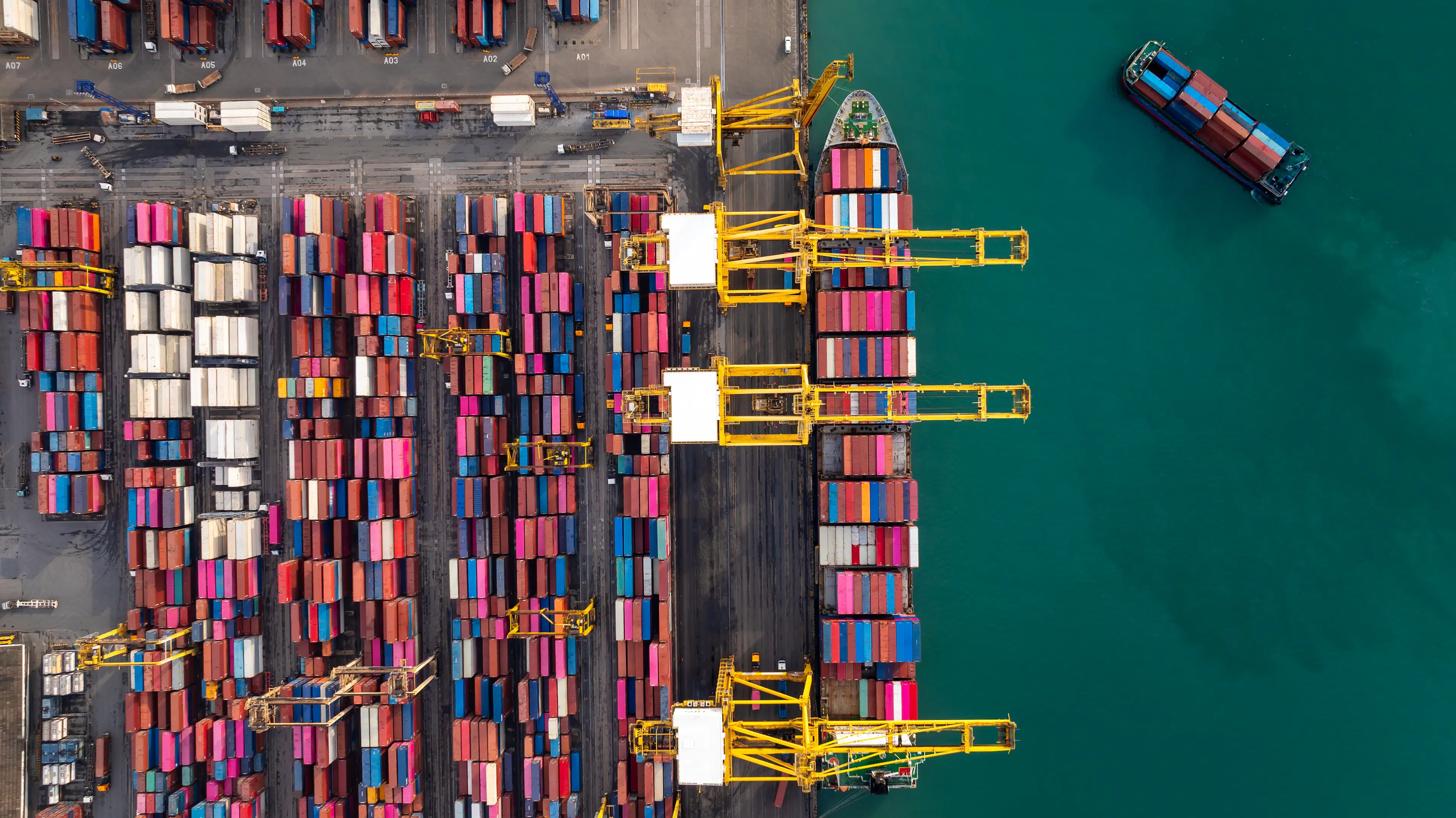
Then there’s the container problem. This is one that doesn’t show up in oil price charts at all. Ships that rerouted around the Cape of Good Hope didn’t just add time; they threw off the entire cadence of container flows. Boxes that should be in Rotterdam are still at sea. Ships that should be loading in Jebel Ali are delayed. Port berth schedules, built with tight tolerances around vessel arrival windows, cascade into backlogs when those windows slip by days or weeks. A signed diplomatic deal between the US and Iran does not move those containers any faster. And as anyone who watched the post-pandemic port chaos knows, once a global container imbalance takes hold, it takes months, not weeks, to work itself out.
The Full Picture
Run your eyes back up that tower. Cooking gas. Gasoline. Plastics. Jet fuel. Diesel. Ship fuel. Asphalt. Every rung of the industrial economy appears somewhere in that column. A sustained disruption at the Strait of Hormuz is not an oil story. It is an everything story.
For investors, crises like this one tend to clarify where the real vulnerabilities are and where the opportunities for investment lie. The Strait closure crystallizes three of them for me.
The first is supply chain visibility. The disruption laid bare how little real-time intelligence most companies have over their own inputs. They knew their goods were on a ship somewhere. They didn’t know which route that ship was now taking, how far it had deviated, or when it would actually arrive. The market for real-time, geopolitically-aware supply chain visibility software is still relatively early and underpenetrated — and the case for it has never been easier to make to a skeptical procurement committee. AV portfolio company Loadsmart is an example of a startup breaking into this space.
The second is alternative feedstocks and energy resilience. Naphtha’s chokehold on plastics production is a vulnerability that consumer goods and packaging companies have been slow to address. Bioplastics startups building petroleum-independent feedstocks benefit directly from the likelihood that petrochemical supply will remain volatile for years. So do companies developing sustainable aviation fuel (SAF), like AV portfolio company AIRCO, which reduces commercial aviation’s dependence on Jet-A fuel refined from Hormuz-transiting crude.
The third is maritime propulsion. Heavy fuel oil is the lifeblood of ocean shipping and one of the most geopolitically exposed links in the entire chain. Companies developing alternative propulsion — ammonia-capable engines, LNG retrofits, wind-assist systems — aren’t only decarbonizing the fleet; they’re reducing its dependence on a fuel source that can be disrupted by a 21-mile waterway. A great example of a startup in this space is our portfolio company Maritime Fusion, which is pioneering the development of nuclear fusion propulsion for commercial shipping.
The Strait will likely reopen. When? I do not know. But the lesson of the past several months is that the global economy’s exposure to a single narrow chokepoint is way too high. The cost of closing the Strait was never just at the pump. It was in every product that traces its origin to that 150-foot tower of steel, which, as it turns out, is most of the things that make modern life run. Companies solving these problems are well-positioned regardless of what gets negotiated.
This communication is from Alumni Ventures, a for-profit venture capital company that is not affiliated with or endorsed by any school. It is not personalized advice, and AV only provides advice to its client funds. This communication is neither an offer to sell, nor a solicitation of an offer to purchase, any security. Such offers are made only pursuant to the formal offering documents for the fund(s) concerned, and describe significant risks and other material information that should be carefully considered before investing. For additional information, please see here. Achievement of investment objectives, including any amount of investment return, cannot be guaranteed. Co-investors are shown for illustrative purposes only, do not reflect all organizations with which AV co-invests, and do not necessarily indicate future co-investors. Example portfolio companies shown are not available to future investors, except potentially in the case of follow-on investments. Venture capital investing involves substantial risk, including risk of loss of all capital invested. Diversification cannot prevent investment loss; it is a strategy to mitigate investment risk. This communication includes forward-looking statements, generally consisting of any statement pertaining to any issue other than historical fact, including without limitation predictions, financial projections, the anticipated results of the execution of any plan or strategy, the expectation or belief of the speaker, or other events or circumstances to exist in the future. Forward-looking statements are not representations of actual fact, depend on certain assumptions that may not be realized, and are not guaranteed to occur. Any forward-looking statements included in this communication speak only as of the date of the communication. AV and its affiliates disclaim any obligation to update, amend, or alter such forward-looking statements, whether due to subsequent events, new information, or otherwise.
Interested in Seeing Curated Venture Deals?
- Home
Easy Sign-Up
Click a button. 5 seconds. - Home
No Obligation to Invest
Only invest in deals you like. - Home
Co-Invest Alongside Leading VCs
Frequent co-investors include a16z, Sequoia, Khosla, Accel, and more. - Home
Deal Transparency
Due Diligence and Investment Memos provided. Live Deal discussions with our investment teams.